Tag: ABC art

  • Making space for the invisible architecture of the social

    Making space for the invisible architecture of the social

    Gail Hastings professes to be a sculptor, but she is an unusual one. Her works often consist of such unfamiliar sculptural media as watercolours or pencil drawings. Her subject matter is equally unusual. It often features pages that look as if they have been transplanted from some esoteric encyclopaedia or otherwise may contain snippets of an overheard conversation. These tantalising elements are in turn ‘housed’ within Hastings’s finely constructed abstract, geometric spaces.

    The effect is like walking into an abstract painting, except to say that one may also encounter text, specially devised furniture or intricate floor plans that actively shape the space of the work. Hastings regards her works as ‘sculptural situations’ rather than as paintings or installations, or even sculptures. Rather than adhering to a pre-existing location, Hastings seeks to craft space – in particular, she seeks to craft an inter-subjective space, a social space of conversation and communication. This is at once a remarkably fraught, ambitious and fascinating enterprise. It is also one reason why the experience of Hastings’s evocative situations is like confronting something vaguely familiar, yet weirdly opaque.

    Hastings thinks of our inter-subjective space as a kind of invisible architecture comprised of both intersecting and dissecting personal and public-social trajectories. Think of how conversations in cafes are usually private, sometimes intimate, although they are conducted in a highly public forum and thus often easily overheard. Or think of how mobile phone conversations connect two people in quite separate places, while at one end a participant may carry on the conversation quite audibly and unselfconsciously as if ensconced in some imaginary private booth. Once the speakers hang up, it is as though they have been transported back to the formal composure of public space.

    We are constantly reminded that we are social beings, but our shared space is often the arena of our greatest anxieties as much as of our greatest joys and satisfactions. The ideal of public space and of conversation is the perfect accord: every voice heard and the coming together of contrasting elements in the golden glow of harmonization. Our anxieties intrude when we feel that this ideal evades us or when we are left to negotiate less than satisfactory social transactions. The ideals of art were once very similar – the perfect accord, the ideal narrative – yet today contemporary art addresses different ambitions by focusing upon the peculiar in the familiar and giving the readily familiar a peculiar outlook.

    Hastings is very contemporary in this sense. She professes her frustration at the struggle ‘to make actual space perceivable in a work of contemporary art’ even though it is the great ambition of her work. This is perhaps why the superbly crafted spaces of Hastings’s work convey an air of serenity or of determined order, while at the same time leave the lasting impression of some kind of riddle or mystery. The visual-textual cues invariably deposited around her elegant, abstract spaces hint at some undisclosed plot. These cues actually constitute a set of disparate spatial-temporal markers delineating the seemingly tangible, but elusive ‘architecture’ of inter-subjective space. The works thereby hinge upon an ambiguous aspiration: they strive to present the most composed and tightly unified work possible, while devising a space sufficiently evocative that it is open to vivid and at times unaccountable inter-subjective projections.

    Hastings’s sculptural situations often interweave disparate clues suggesting a transit in time and space. The employment of spatial and temporal cues is one of the distinctive features of Hastings’s art. In an earlier work, Encyclopaedia of a moment’s evidence 1993, each fastidiously designed and hand-rendered page – purportedly from this cryptic encyclopaedia – looks like some arcane activity sheet recording a mysterious quest for knowledge. The passage of time is surreptitiously inscribed in Times font, yet the page numbers do not reveal a sequence at all but simply repeat page five each time. They appear like pages from an unfathomably stalled text because the sequence goes nowhere, except spatially from room to room. We encounter a busy, episodic circuit signalling a pursuit or a quest, as if striving to render significance, although barely registering in time.

    Plate 3: Moment 12.00pm
    At 12.01, she hurriedly enters room A
    in urgent search for the evidence of mo-
    ment 12.00pm. She finds it. [5]

    Plate 4: Moment 12.00pm
    At 12.01, assured that the evidence of
    moment 12.00pm was in room B, she
    entered, but too late. The evidence had
    been wiped away. [5]

    Plate 5: Moment 12.00pm
    If evidence of the moment 12.00pm ex-
    isted, it would be found in room C. She
    enters room C at 12.01 and she finds no evi-
    dence of moment 12.00pm. [5]

    The clipped syntax mimics the text inscribed by an old typewriter, which harshly ‘justifies’ the lines by abruptly breaking words in two (even though every line of the work is carefully delineated by hand). Breaks too occur in the flow of ‘evidence’. Is a case building, or evaporating?

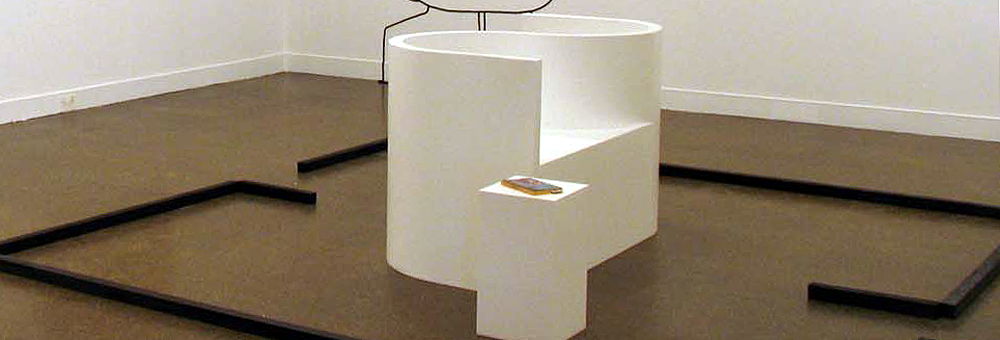
    A different example of such temporal-spatial puzzles is found in Room for love 1990, which contains a conversational or ‘tête-à-tête’ chair, an S-shaped two-seater sofa, sometimes called a ‘love chair’. In such a chair, two people sit in close proximity facing in opposite directions, although they can also converse face-to-face. For Hastings, the analogy alludes to the often-fraught dynamics of social interaction as well as to the reception of art: ‘the chair was intended as a conversation with oneself when one looks at a work of art – where two opposing views are struck – literally –while there is also this third, reconciliatory view of turning halfway toward the opposite view’.1  [See a detail image of Room for love above]

    The analogy is highly suggestive. For instance, this piece of writing aims to explicate the work for a reader who may have already experienced it, but like the ‘tête-à-tête’ chair it aims to turn the viewer around again to face the work, although differently. It may even extend the understanding of the work beyond conceptions ordinarily entertained by the artist. The analogy also recalls the puzzled status of art in the wake of post-minimalist art, which prompts questions such as: what is the ordinary, quotidian object and what is the artwork? What does it do? As the art historian Thierry de Duve notes of the minimalists, ‘far from freeing themselves “from the increasing ascetic geometry of pure painting”, the minimalists claimed it and projected it into real space’.2 This is what Hastings does, except that she stage-manages this extended state of puzzlement over the status of art.

    With her latest work, referencing Walter Burley Griffin and Marion Mahoney Griffin’s partially realised plan for Canberra, Hastings shifts attention from puzzlement over the confounding qualities of post-minimalist art to the earlier aspirations of such abstract, geometric visual languages associated with the urge to forge a common, equitable social space. This ideal was typified by the Griffins’ thwarted plan to place a library at the apex of Capitol Hill just above Parliament House. Hence, the aim was to erect a space for knowledge and reflection at the apex of its social-symbolic space, a place devoted not only to historical memory but to the on-going articulation and re-articulation of the shared space of a nation. The Griffins are perfect for Hastings’s purposes because they intertwine the aspirations of an abstract visual language with a similar concern for social space – and this has tempted some to interpret secret or esoteric meanings behind their elaborate designs.3

    Hastings perhaps recalls an ideal space for art, but one that has escaped it throughout modernity. Her persistent and distinct art practice attempts to yield an inter-subjective space, which defies her as well as art in general, but which also eludes each and every one of us daily. Yet such an irrevocably intangible space is regularly experienced in keenly felt ways and this is what Hastings magically aims to manifest. The Griffins once aimed to make the ‘invisible architecture’ of a nation explicit whereas today (ironically) it lies buried within the confines of parliament. In striving to make that invisible architecture of intersubjective space perceivable, Hastings’s art rearticulates that vision for a contemporary audience. Hers is an art, however, that evokes the formal composure of the original Griffin plan – with its ideal apex now buried and remote – and we soon realise that it is attuned to what may just as readily escape us in conjuring this formal composure.

    1. Gail Hastings, private communication with author. []
    2.  Thierry de Duve, Kant after Duchamp, MIT Press, Cambridge, MA 1996, p 218. []
    3. James Weirick, ‘Spirituality and symbolism in the work of the Griffins’ in Anne Watson (ed), Beyond architecture: Marion Mahony and Walter Burley Griffin in America, Australia and India, Powerhouse Publishing, Sydney 1998, pp 56–85. []
  • Withdrawal from ‘Less is More’

    Withdrawal from ‘Less is More’

    On Monday 3 September 2012, ABC art: red cube (2008) was taken off the exhibition wall of  Less is More at Heide Museum of Modern Art before the exhibition’s conclusion, upon my request. This was a drastic and, for me, painful action made necessary given there was no retraction of the curator’s views expressed in the exhibition’s catalogue and, hence, no alternative even though, to this day, I respect the curator very much.

    Here, I directly address the misrepresentation of ABC art: red cube.

    The section of the curator’s text that frames my art’s inclusion is in Part III, ‘Notes on Contemporary Post-Minimalism’, and entitled ‘The viewer’ — which reads:

    It was Robert Morris, more than any other minimalist, who brought the viewer and their field of vision to the fore in his articles about Minimal art. The spectator, more strongly aware than before of being in the same space as the art object, apprehends it ‘from various positions and under varying conditions of light and spatial context’. The object is ‘but one of the terms in the newer aesthetic’, he wrote [in Notes on Sculpture, 1966].

    … A shift in emphasis from the art object to its perception by a viewing subject is a key turning point between the modern and postmodern. Artists from subsequent generations, Peter Tyndall and Gail Hastings have in different ways taken this shift to the heart of their practice both focusing on the situational aspects of apprehending art. [p. 67, Less is More catalogue]

    … If Tyndall’s work in the 1970s was shaped by the analytical approach of conceptual art, then Hastings, who emerged in the 1990s, is part of a younger generation who look back on Minimal and Conceptual art with a fresh perspective. For example, Mel Bochner’s Measurement Series from 1967 (a work illustrated in Pincus-Witten’s book Postminimalism) was formative for Hastings. In a self-reflexive gesture, Bochner mapped the measurements of the exhibition space onto the gallery walls using numbers and arrows, creating a diagram of the room commensurate with the actual room. Hastings enjoyed his conflation of real and pictorial space, but where Bochner used feet and inches, she instead preferred ‘more improbable units such as thoughts, conversations and inconsequences’. [p. 69, Less is More catalogue]

    The artwork by me referred to here is Floor plan: Empty, except (1990). It was first exhibited at what is now called Gertrude Contemporary, Melbourne, in 1990 and re-exhibited in the first Primavera exhibition at the Museum of Contemporary Art, Sydney, in 1992.

    Floor plan: Empty, except bookmarked, in particular, New York artist Mel Bochner’s Measurement: Room at Galerie Heiner Friedrich, Munich, where Mel Bochner graphed the measurements of a pre-existing gallery space onto that same gallery space in feet and inches, using letraset and black tape. By bookmarking this piece, Floor plan: Empty, except returned to it at a point in time in Melbourne when it was far from anyone’s mind.

    In returning to it, Floor plan: Empty, except did not graph the measurements of a pre-existing space onto that space as did the Measurement: Room but, instead, graphed the measurements of a ‘created’ space onto that same created space.

    The created space of Floor plan: Empty, except was between opposites: a square and a circle; a Room of Remembered Mistakes and a Room of Mistakes About to be; the past, the future; the physical entry and exit of a passageway. Uppermost, though, the space was created between the opposites of a two-dimensional picture within which one imaginatively roams (a floorplan), and a three-dimensional geometric rendition of that same picture within which one physically roams (note, this and other works of this nature by me precede Kathy Temin’s three-dimensional rendition of a Frank Stella painting).

    This tension between the 2- and 3-dimensions is not to be glossed over as it typifies, for example, my time at the Victorian College of the Arts (VCA), Melbourne, as an undergraduate student in sculpture wherein I encountered minimalism. The sculpture department was, at that time, a non-entity. Not only was it detached from the main art college by being across the road, but traffic between it and the rest of the art college was one way. While we would routinely wander the corridors of our painting, printmaking and photography counterparts, the interest was not returned.

    In Melbourne at the time, ‘art’ was synonymous with ‘painting’. The Dean of the art college was a painter. Although the New York art market had already crashed by the time I began at the VCA — the trickle down effect had just reached Melbourne. Painting, therefore, was still the name of the game. If you were a sculpture student, this fact was borne as one massive chip on our collective shoulder.

    From within this darkness, then, of the disregarded — where I floundered in what would eventually be my study’s non-productiveness — I first encountered minimalism during an art history lecture. Minimalism made the real space of sculpture matter. Minimalism integrated real space with the thoughtful space of art. Minimalism made space active. I was captivated.

    It was as a part of these lectures on minimalism that I first learned of Mel Bochner’s Measurement: Room. Its role, in the story we were told, was duplicitous. On the one hand, it clearly illustrated how minimalism turned the illusory 2-dimensional space of a painting into the ‘real’ 3-dimensional space of a room. We see this in the manner by which the Measurement: Room graphs the ‘x’ and ‘y ‘coordinates of a grid — as per Albrecht Dürer’s renaissance tool, a wooden window inlaid with a wire grid through which he graphed the model on the other side onto his drawing — onto the real space of a room.

    The point here, reiterated by my art history lecturer numerously and in different ways, was that sculpture became relevant through minimalism not because of sculpture and its history, but because of its opposite and its history — painting. This, as a sculpture student, was very hard to take.

    It is, however, what we see in the black hole of Lee Bontecou’s reliefs of the late 1950s that had Donald Judd write in 1965, ‘The black hole does not allude to a black hole; it is one’.

    Here, a black hole bridges the opposition between itself as a 2-dimensional space in a painting, and itself as a 3-dimensional space that is real, the same 3-dimensional space within which we stand to look at it.

    As a bridge between opposites, I understood this black hole as intersubjective even though I did not entirely know what that meant until later, after much learning (still incomplete). Intersubjectivity is the opposite of relativism. It is the reciprocal recognition between oneself and the other (the opposite) upon which our ability to reason is hinged. Its one-to-one concurrence of thought and actual space in minimalism was compelling. This intersubjectivity was not between an artist and a viewer, but between a viewer and that same viewer in opposite positions in relation to a work of art.

    Mel Bochner’s Measurement: Room took place within this black hole that bridged 2- and 3-dimensional space. That, though, is on the one hand. On the other hand, in doing so, the Measurement: Room stepped away from this black hole into a critique of modernity’s systematic standardisation of space manifested through the pragmatics of measurement.

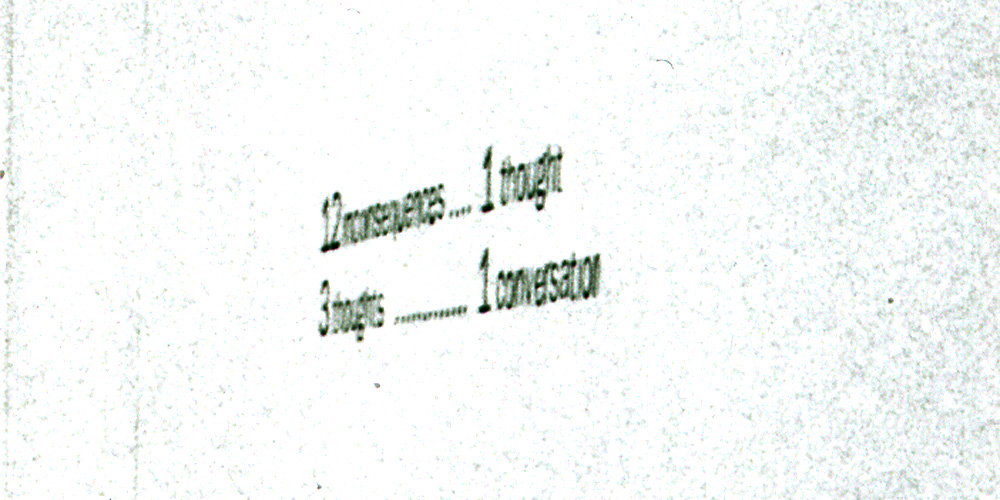
    Against the Measurement: Room, then — in criticism of itFloor plan: Empty, except about faced to step back towards what I perceived as the unfinished business of minimalism. It did so by turning the Measurement: Room‘s empirical measurement of feet and inches (12 inches make one foot, three feet make 1 yard) into measurements whereby thought and space concur: 12 inconsequences make 1 thought, three thoughts make one conversation. Much to my dismay, no one seemed to recognise this difference given no one seemed to recognise the Measurement: Room. This was formative.

    In this way Floor plan: Empty, except graphed the measurements of a created space onto that same created space. This is not the ‘phenomenological space’ associated with Robert Morris, but the space of intersubjectivity’s black hole. Yet the curator’s text for Less is More frames my art within terms of Robert Morris’ phenomenological space.

    It may at first be difficult to appreciate the difference between this phenomenological space and the space of intersubjectivity’s black hole when both seem to point to the same thing. One could even look at Lee Bontecou’s reliefs and describe them in terms from Notes on Sculpture as having taken ‘relationships out of the work‘ — where the relationships, here, form the space of a black hole within the relief — to make them ‘a function of space, light, and the viewer’s field of vision’ — where the space within the relief is made a function of the space within which we stand to look at it.

    Similarities aside, the differences matter. Namely, Notes on Sculpture makes clear that the new art (minimalism) stems from sculpture, alone, without any history of painting. Whether right or wrong, ABC art: red cube did not stem from this understanding but its opposite, as made clear by its inclusion of 2-dimensional elements that, framed by Notes on Sculpture, are rendered invalid.

    Furthermore, Notes on Sculpture denounces a relief’s engagement of real space since, amongst other things, a relief relies on the same wall support as painting and is, therefore, locked into the ‘x’ (down, up) and ‘y’ (left, right) coordinates of painting, unable to partake in the third dimension. ABC art: red cube hangs on the wall and thereby, through inference, is grievously impugned as lacking engagement with real space.

    To have framed my art’s inclusion in the exhibition through reference to Robert Morris’ phenomenological space is to have seriously and severely misrepresented ABC art: red cube. An informed understanding of this framing cannot help but see ABC art: red cube as incompetent on all counts.

    Moreover, by framing my art this way, the curator short circuits the space of intersubjectivity’s black hole, given its historical scaffolding is eliminated in preference of phenomenological space.

    On its own, ABC art: red cube is quick to make friends, so why withdraw it from Less is More when, most likely, few have or will read the catalogue?

    Even if only one person reads the catalogue, ABC art: red cube is misrepresented. When the next person decides to focus on minimalism in Australia in any way, it is this catalogue they will read. Without indication ABC art: red cube has been misrepresented and without financial support for research assistance, which is most likely, they will take what is written on board even though they realise catalogue texts are the views of the writer and not necessarily of the artist. Artist’s don’t necessarily get it right, either. Nevertheless, misrepresentations so very easily become entrenched as art history. ABC art: red cube has much more to give than that.

  • Thank goodness Donald Judd wasn’t a misogynist

    Thank goodness Donald Judd wasn’t a misogynist

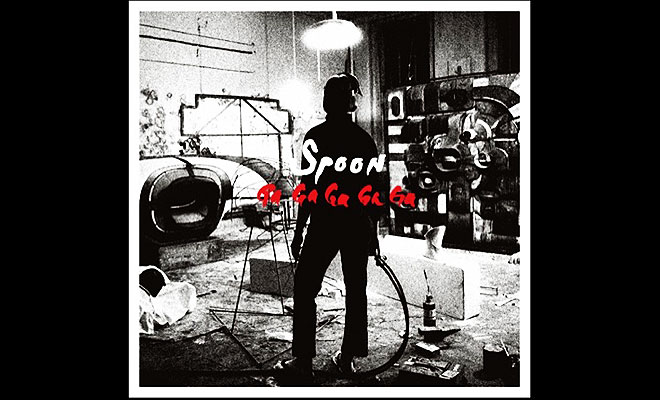
    While browsing iTunes one fine July 2007 day, I happened upon a new release by Austin Indie band ‘Spoon’ with a cover image of the artist Lee Bontecou by photographer Ugo Mulas, taken in 1963.

    Instantly impressed, I eagerly investigated further and came across an interview. Here, singer/guitarist Britt Daniel explains that, although he was not aware of the sculptor before coming across the image, the image immediately struck him as typifying the mood he felt about the record. ‘It’s just this guy, Bontecou, looking at all these pieces of debris’ says the interviewer, to which the singer replies, ‘Yeah, and they’re weird pieces. Or colorful. They just are’.

    While I suggest the singer had his band’s songs more in view than Lee Bontecou’s art by his reply (as Lee Bontecou’s art, of that time, was pretty much dark and light with a lot of dirty looking tones between), what is nevertheless startling is that, rather than inform the interviewer Lee Bontecou is female, the singer instead revealed he, too, thought Lee Bontecou is male; for which reason, it now becomes obvious, he felt an affinity.

    The mistake would have been mortifying for the singer once discovered, which it was, as made evident by another interview some weeks later. Had he realised earlier, the impetus behind the cover’s selection would not have been there and another image would have appeared in its place. So I am glad of the mistake, as it has produced one of the most arresting album covers I have seen in a long time.

    Although these mistakes are everyday and unworthy of being held ransom to, this one is nevertheless uncanny since it bespeaks a silent tragedy that has throttled a vital understanding of contemporary art from around the time the photo was taken up until today. For what this mistake reveals—given the singer most likely comes from a progressive background—is that even under such an enlightened perspective, an innate prejudice still persists in society to the extent certain postures are read as male, only. The blowtorch, a back turned rather than a front offered, independence of mind, an absorption in one’s work, a disdain for conformity, taking one’s time and our gaze directed in a non-objectifying way spell male artist, not female. If this is now, no wonder Lee Bontecou’s art was treated as threatening in New York’s decidedly male dominated art scene of the late 1950s—back then.

    For these reasons, Lee Bontecou’s art could have easily been dismissed by the minimalist artist Donald Judd who was on the job, at the time, as an art writer as a means to fund his then relatively unknown studio practice. If the catalogue essay for the present exhibition Less is More is right in its description—where, ‘for him, less (or non) of some things—symbol, narrative, illusion, incident—meant more of an emphasis on others—like dimensionality, shape, ‘material as material’ and an engagement with real space’—then Donald Judd’s dismissal of Lee Bontecou’s art should have been par for the course. But, it wasn’t.

    Instead, Donald Judd recognised in Lee Bontecou’s art a paradigm shift. Even the term most associated with Donald Judd—‘specific objects’—was first formulated, as the art historian Richard Shiff points out, in 1963 when describing a Lee Bontecou relief as ‘actual and specific and … experienced as an object’. (GH, The process of specific space, 2009.)

    According to the New York Times art critic Roberta Smith, Specific Objects is one of the three most significant contemporary art essays to this day (ref). The other two are Clement Greenberg’s Modernist Painting (1960-1) and Michael Fried’s Art and Objecthood (1967). It was written in 1964 when Donald Judd was assigned to write a survey article of the present art situation, yet was not published until the end of 1965. Its opening sentence is now iconic: ‘Half or more of the best new work is the last few years has been neither painting nor sculpture’. (ref.) Written afterwards, though published months before, is another text by Donald Judd that opens: ‘Lee Bontecou was one of the first to use a three-dimensional form that was neither painting nor sculpture’. (ref.)

    In these works by Lee Bontecou of that time (see Slide 4 above), we see an eruptive force explode a gridded picture plane into the actual space of the room. ‘Bontecou’s constructions stand out from the wall like contoured volcanoes. Their craters are voids but exceedingly aggressive ones, thrust starkly at the onlooker; these are threateningly concrete holes to be among’, wrote Donald Judd in 1960. The resulting radiation of concentric circles intrude upon the usually segregated space of a viewer, with a black gaping hole at the centre.

    ‘The black hole does not allude to a black hole; it is one’, wrote Donald Judd in 1965. Posited, then, at the centre of a pictorial space was a black hole of real space. In being real, the usual segregation between the pictorial space of a work of art and the real space of a room in which we look at that work of art, had been violated. As a result, the artwork’s black hole moves between opposing poles as a space that includes us (real space) and a space that excludes us (pictorial space).

    Upon observing this dialectical action of space, Donald Judd took it back to his studio as a tool that helped redefine his art into the art we recognise as his, today. He later describes it as created space. It is an active space opposite to the space we have come to know through the writing of Robert Morris, which is a passive space—such as the given space of a room. The difference between the two may be difficult to comprehend, especially as Donald Judd is broadly known as laying heavy emphasis on the ‘given’ — on ‘material fact’— which would lead one to think the space of his art is the same room space as Robert Morris’, but it is not. Real space, for Donald Judd is not found as is the space of a room, but created.

    To understand this difference we have to remember Donald Judd majored in philosophy at Columbia University. Much in philosophy focuses on the question of truth, such as: how do we know the representation of an object in our thoughts corresponds with the actual object outside our thoughts. In other words: how do we know we are not just imagining it? Post-modernism’s reply is that we cannot know, since everything is relative: what I see from my perspective will be different to what you see from your perspective.

    If we are locked into our own perspective, then it is easy to be held captive by our own prejudice. We see an example of this in America’s political far right, who insist President Obama has no legitimacy to be President since he was not born in America; a belief they hold onto even though the White House has released the President’s birth certificate (the fact of the matter) that proves otherwise. Relativity, therefore, knows no bounds; facts don’t figure.

    You can see why Donald Judd would not have championed post-modernism and its accompanying relativism, given he was on the side of facts. What this means is that, rather than start from a position of self-certainty, barricaded in by one’s own perspective, one instead starts from a space of uncertainty, moves beyond it, takes up the space of the other (facts), from which one then returns with knowledge of the other. As Richard Shiff has said, ‘Judd was more of a viewer than most viewers are … [he] recognised the danger of starting his position as definitive’ (ref). Instead of a perspective without bounds, facts—the other—holds it in check. In philosophy it is known as intersubjectivity. It is the opposite of relativism.

    When Donald Judd observed a dialectical act of space in Lee Bontecou’s art, he recognised in it the dialectical act of intersubjectivity. Thought, then, that creates this dialectical act of space does not take place in the private space of oneself, but the public space outside oneself: the space of the other, of ‘facts’ — the artwork.

    As I have written earlier:

    Robert Storr, when recently writing on Lee Bontecou who ‘dropped out of the art world at the height of her fame in the mid-1970s’, points out that, ‘Writing someone back into art history thus entails risks both for the writer and the artist’. Critically unmeasured advocacy, or ‘sins of commission’, can cause more damage than past writers’ ‘sins of omission’.

    Without refrain, nevertheless, Robert Storr little flinches when pointing out one drastic omission in particular, that of Lee Bontecou’s work by Rosalind Krauss in Passages of Modern Sculpture (1977); a book that ‘established the canon for many curators and critics with power in or over major institutions’. Drastic, in that, to ‘be left out of the book meant oblivion in many academic circles where histories are constructed’.

    Mentioned are just five women sculptors: Louise Bourgeois, Barbara Hepworth, Eva Hesse, Louise Nevelson and Beverley Pepper. ‘None except Hepworth and Pepper rate more than a line or two and a text figure’.

    With this he points out, ‘Robert Morris, the sculptor-critic of the 1960s to whom Krauss’s work is heavily indebted, did not discuss Bontecou in his Continuous Project Altered Daily’; added to which, ‘Krauss’s other mentor Clement Greenberg did so once, only in passing and disparagingly at that’ (ref).

    In a footnote Robert Storr adds:

    I have emphasized Judd’s role in critical literature on Bontecou in part because his ability to recognize and eagerness to champion her work are key to understanding his position. Judd’s … tough-minded thinking … never takes the fatal step into prescriptive or proscriptive dogma commonly taken by other formalists of the period. Like Lippard, Judd was a writer of strict standards, and was open to arguments that diverged from the perspectives he primarily adopted. Although opinionated, he was an aesthetic empiricist and a pluralist. Moreover he was alert to artists work outside the mainstream, and seemingly at odds with the classicism of his own approach, as if these artists spoke for the eccentric or grotesque parts of his own sensibility that he had subordinated to his formally severe methods and means. (ref)

    In accrediting Donald Judd for championing Lee Bontecou’s art, we also see Robert Storr flounder a bit in trying to understanding why he did so, to end up suggesting Lee Bontecou’s art may have spoken for a subordinated part of his own, when nothing of the sort is the case. Yet, to suggest this indicates Robert Storr is not familiar with the type of space of Donald Judd’s art, nor the role of Lee Bontecou’s art in its genesis. This is not surprising for the reasons he himself has revealed, in which we see the effect of an invisible misogyny determining an art historical account even in modern times.

    This is also apparent in James Meyer’s books on minimalism in which the space of Donald Judd’s art always comes off as a poor man’s Robert Morris, since Robert Morris’ is the only understanding of space the writer acknowledges. Within its context Donald Judd’s art is judged both badly and mistakenly.

    The Less is More catalogue follows this pattern and, by doing so, reenacts an inherited misogyny. As a result, Donald Judd’s main concern is left out: created space.

    Minus its proper nomenclature (‘created space’) and minus recognition of its genesis, this is the space to which I was introduced as minimalism when an art student in the late eighties at the VCA, Melbourne. Sitting in the dark of a slide show, with an art history teacher decrying again and again ‘but don’t you see’ while projecting an image of a Donald Judd piece (see Slide 5 above), I have to admit at first I didn’t. No matter the times he described the work in terms not unlike those I’ve used to describe Donald Judd’s observations of Lee Bontecou’s art, and no matter how beseeching his ‘but don’t you sees’ became—I just didn’t. All I could see was a grainy black and white photo of a number of fabricated metal boxes lined up in a row, industrial looking, hard, uninviting, purposively made yet seemingly pointless—with another row mounted on the wall behind. None of this seemed ‘new’ nor exciting, let alone anything to do with ‘space’. Once you’ve seen a metal box you’ve seen a metal box, what more is there to see?

    A little shocked by my negativity, I finally decided to notice something I had been staring at but avoiding to see because it seemed so pointless: a black hole opening at the end of a rectangular tube inset horizontally along the top front edges of the boxes, joining them. In finally seeing this comparatively small black hole, it drew my imagination beyond the prejudice that had previously held me back. My thoughts now zoomed along the narrow tunnel’s darkness, aware of the blackness’ constricted space, length, openness and frictionless speed. Then suddenly, I was jettisoned into its opposite: the internal comparatively vast blackness of the first metal box that was closed, contained, motionless and in which I felt stuck.

    Shocked, my eyes focused on the box’s metal exterior that now gained a hitherto unthought-of thinness that gave me surprising comfort, in an effort to hoist my thoughts out of the box’s dark insides and back into the light. Safe again, my focus gravitated to the shadowed gap between the first and second boxes that took on a robust thickness compared with the metal thinness sandwiching it on two sides. With this, I finally understood my art history teacher’s exhortations to see our conscious thoughts taking place in this space outside us, rather than in the dark of our physical self (he was, admittedly, German and no doubt brought up on the philosophy that allowed him to draw our attention to this).

    Then the slide projector revved into motion as the next slide lunged into view, when I had only begun to see the previous one. How did Donald Judd orchestrate all this space intact with intricate differences that seemingly exploded from nowhere? How was it possible not at first to see what was now so abundantly present, when before all I could see was a row of metal boxes? And how were my thoughts taking place out there, amidst all that, rather than locked away in the privacy of me?

    From that day on I have been dedicated to minimalism. While I admit I have, at times, been lazy in my observations and have sometimes been swayed by criticisms before recognising their fallacies, I have never lost sight of how minimalism makes fundamental experience a self-consciousness of our freedom.

    The piece by Donald Judd described above, Untitled 1966, was exhibited in the exhibition Primary Structures at the Jewish Museum, New York, in April 1996. In the catalogue for the exhibition, Donald Judd writes:

    ‘I object to several popular ideas. I don’t think anyone’s work is reductive. The most the term can mean is that new work doesn’t have what the old work had. … New work is just as complex and developed as old work. … Prior work could be called reductive too; … compared to the new work it would even mean less, since then much of its own meaning would be irrelevant’. (ref)

    The point here is that every period of art throughout history is ‘reductive’ since it includes less of the period preceding it, to make way for what is new. Use of the term to differentiate one period from another is therefore redundant. Moreover, as one can see by the description of space above, this art involves extraordinary complexity, not reduction. As long as one continues to call it ‘reductive’ one continues to negate its complexity and thereby negate what is truly new.

    To move beyond a ‘reductive’ understanding of minimalism, I suggest you start with Donald Judd’s piece included in Less is More. First, free yourself of the limitations with which you might at first perceive it (it’s just a well crafted metal box, open on two ends with coloured perspex inside that sits on the floor and around which I can walk), by finding what you keep staring at but, because of these limitations, keep refusing to see. Then hold on to your hat as you get drawn into an architectonics of space at the very moment of being made, where ‘physics and fantasy are indivisible within an impossible spatial möbius’.(ref)

    In the end, you might also find yourself thankful Donald Judd did not dismiss the importance of Lee Bontecou’s art when most did. Thankfully, there is an increasing number of art historians who seek facts over hearsay and who have, as a result, rescued the created space of Donald Judd’s art from the oblivion of misogyny’s tragic graveyard. Foremost, of course, is Richard Shiff, as well as David Raskin, including curators who worked with Donald Judd, Marianne Stockebrand.

    As an appropriate ending, then, it is worth having a listen to one of Spoon’s more popular tracks on this 2007 album with Lee Bontecou in her studio on its cover. For uncannily, although the selection of this image was the result of mistaken identity, the track suggests no mistake was made at all but, rather, as the song goes … ‘the call of a lifetime ring’ … (Britt Daniel, The Underdog).

    Lyrics here (better listening, too).


    NB: Most of what is said here is based on premises established in an extensive manner in: Gail Hastings, The process of specific space: Minimal art generally, Donald Judd’s art particularly, The University of Sydney, 2009.

  • Why I make editions: A space for possibilities

    Why I make editions: A space for possibilities

    A ‘limited edition’ is a term we generally associate with printmaking or photography in contemporary art. Both involve the reproduction of an artwork a number of times. If the ‘number of times’ is limited to, say, 100 prints, then the artwork is an edition of 100.

    There is a problem here, however, with the word ‘reproduction’. For the word suggests it is an original artwork that is copied. The ‘original’, however, from which a contemporary print is pulled is not, in fact, an artwork but a block of wood, piece of lino or etched metal plate. While in photography, if digital, it is a raw image file of electronic signals turned into 0’s and 1’s.

    Technically speaking, then, each print is not a ‘copy’ of an artwork, but an artwork in itself. As ‘originality’ is one of the most persisting measures of a work of art, the question therefore arises as to how a contemporary print can be original and a reproduction at the same time.

    If originality rests on difference, we can find difference within printmaking by the fact a source degenerates, through wear and tear, each time a print is taken. As a result, each print is particular in its departure from the ‘whole’. If, however, its departure is too original, the print loses its value as part of a whole. Originality, as such, takes on certain parameters within which any shift too great breaks the context that defines it.

    The relation between the whole and its parts, the prints, is therefore interesting. In certain ways it is not unlike the relation between the ancient philosopher Plato’s pure forms — ideas — and the objects derived from them. A pure form, for instance, could be a bed. If we think of all the beds built throughout time, each and every bed is but a reproduction of the one true bed, the absolute bed, the idea of a bed.

    Yet this idea of a bed is not something we can actually pull back the covers of and sleep in. Its reproductions, however, as the concrete objects that populate our bedrooms, are.

    Similarly, although the abiding image of a contemporary print edition is reproduced by each print, it — as an object itself — does not exist.

    Accordingly, there cannot be two (or more) ideas of a bed, only one ideal bed from which others are derived. An original cannot be a copy at the same time. For ‘if there had been two’, writes Plato in The Republic, ‘there would always have been a third — more absolute and abstract than either, under which they would have been included’. The third, therefore, would be the original and the other two its copies.

    This, though, flies in the face of a contemporary print being an original as well as a copy. There is nevertheless still a similarity. An Ideal form is a whole that includes its reproductions, just as a print edition’s abiding image, the conglomerate of all that is common in each print, is a whole that includes each print’s similarities.

    This parallel between Plato’s pure forms and a limited edition is, however, an awkward one to make today. Any Platonic notion of a pure Idea or absolute Ideal has been permanently besmirched for any artist working on this side of minimalism.

    A non-material form we cannot physically experience (the idea of a bed) is no longer more ‘real’, as in Plato’s day, than a material object we can physically experience (a concrete bed). The real is no longer God given (Plato’s forms), but earth bound (minimalism’s objects). Experience no longer confounds understanding (Plato) but is its foundation (minimalism). Minimalism is the ‘art of the real’. ((The art of the real; USA, 1948-1968 was the title of the 1968 exhibition curated by E.C. Goossen that included works by the minimalists and which travelled to Europe.))

    Post modernism, of course, took anti-Platonism further to obliterate the ‘pure’ entirely.  In this way ‘particularity’, in all its cultural, social, sexual and technological difference, is here to stay. Difference is defiance. Under such sway, the ‘whole’ is secularised blasphemy.

    This, for me at least, is a problem. I consider the ‘whole’ — albeit generally unrecognised — integral to minimalism, and I love minimalism. With everyone busy burning the ‘pure’ to much applause, no one appears to realise they have used the ‘whole’ as kindle. No art history lecture or essay have identified this. It has been a problem without words for me, for so long. Until, that is, I began to make editions.

    The first edition I made was during a six-month Power Institute studio residency at the Cité Internationale des Arts, Paris, in 1995. Not that I thought of or called the art I subsequently made an edition at the time. It was, rather, a nameless urge inspired by a purchase I made from the lower floor hardware section of the Bazar de l’Hôtel de Ville department store.

    The Bazar de l’Hôtel de Ville, as some will recall, is where in 1914 Marcel Duchamp purchased the first ‘unassisted’ readymade – the Bottle Rack (1914). ((See Thierry de Duve, ‘Kant after Duchamp’, An October Book, The MIT Press, p. 250.))

    Now treated with the conservator’s white gloves of art history as one of its most precious contemporary art objects, at the time this first unassisted readymade was unceremoniously dumped in the rubbish by Marcel Duchamp’s sister when tasked with clearing his studio after his departure for New York. Not until 1921 was a replacement purchased. ((See the National Gallery of Australia‘s notes. ))

    With this we have another parallel with a Platonic pure form. While many replicas have since ensured this first unassisted readymade retains its place in history, we only know this bottle rack through its replicas since it, itself, like a pure form, does not materially exist. ((Based on notes from the National Gallery of Australia‘s website, in 1921 Marcel Duchamp purchased a replacement (collection: Robert Lebel, Paris); in 1945 Man Ray purchased a third replica; in 1960 Robert Rauschenberg purchased a fourth replica in New York; and in 1963 a fifth was made for the Moderna Museet, Stockholm. In addition to which, in 1964, an edition of eight was made by Galleria Schwarz, Milan — of which the National Gallery of Australia has one. See picture.))

    It was not this, admittedly, that had me repeatedly traipse up Rue de Rivoli to ransack the basement floor of the Bazar de l’Hôtel de Ville to see, embarrassing as it is to admit, if they might perchance still sell the same bottle rack. They do not. Yet, in seeking it, I was captivated by how Duchamp’s 1914 bottle rack was but one of an unintentional limited edition. Each bottle rack was a reproduction of an Ideal bottle rack, the bottle rack each customer thought they had purchased before they discovered the idiosyncrasies, the faults, the particularities, of the one they actually purchased. Having signed an idiosyncratically ridden bottle rack, Marcel Duchamp effectively replaced the ‘Ideal’ in art that is pure and original, with a ‘particular’ that is impure and banal. He replaced the ‘whole’ with a ‘part’.

    If only I could make the same retrospectively inspired, though at the time ‘disinterested’, purchase. I tried, but failed.

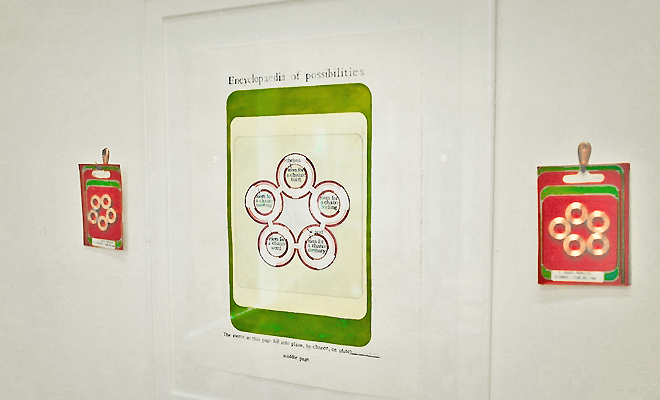
    No matter on how many days I searched the basement, I had finally to realise I was no Marcel Duchamp (how arrogant, I know, to have even presumed otherwise). I accepted failure, then found something. Not a readymade, but a vacuum pack of brass circles arrayed in a geometric flower pattern, on a hot magenta and lime green board.

    Each pack of five rings reproduces the same pattern, differently. Each represents a possibility within a certain set of circumstances that delimit a whole space. I bought quite a few packs, took them back to the Power studio at the Cité and made the same work over and over — enamoured by a ‘whole’ from which each possibility derived.

    I took these with me to Düsseldorf, as I was about to have an exhibition there. The gallery director — Thomas Taubert — suggested we sell them as a limited edition. ((Encyclopaedia of possibilities, 1995, a limited edition of three, each of three parts, was exhibited in To make a work of thoughtful art, Ausstellungsraum Thomas Taubert, Düsseldorf, in 1995.)) I have made numerous editions since.